

Edmonton is one of Canada's strongest residential solar markets.
With 2,300+ hours of annual sunshine, up to 17 hours of daylight in late June, a cold climate that improves panel efficiency, and Alberta's deregulated electricity landscape, typical Edmonton solar payback periods sit between 6 and 10 years.
At Firefly Solar, we have an Edmonton local office and substantial install footprint across the Edmonton metro area. This guide walks through what solar costs in Edmonton in 2026, what payback looks like for a typical EPCOR-served home, and the key Edmonton-specific caveat: the Change Homes for Climate program is multi-unit only, not single-family.
Key Takeaways
- Edmonton's typical residential solar payback is 6 to 10 years.
- A typical 8 kW Edmonton system costs $20,000–$28,000 pre-incentive and produces 9,500–11,000 kWh annually.
- CEIP 6% financing is available in Edmonton, attached to property tax over up to 20 years.
- Change Homes for Climate is MULTI-UNIT residential only ($0.50/W up to $4,000). Single-family homes are not eligible.
- Net metering with EPCOR or your retailer applies under the Alberta Micro-Generation Regulation.
Why is Edmonton great for solar?
Edmonton combines high sunshine, long summer daylight, cold-climate efficiency, and Alberta's deregulated electricity market.
2,300+ hours of bright sunshine annually
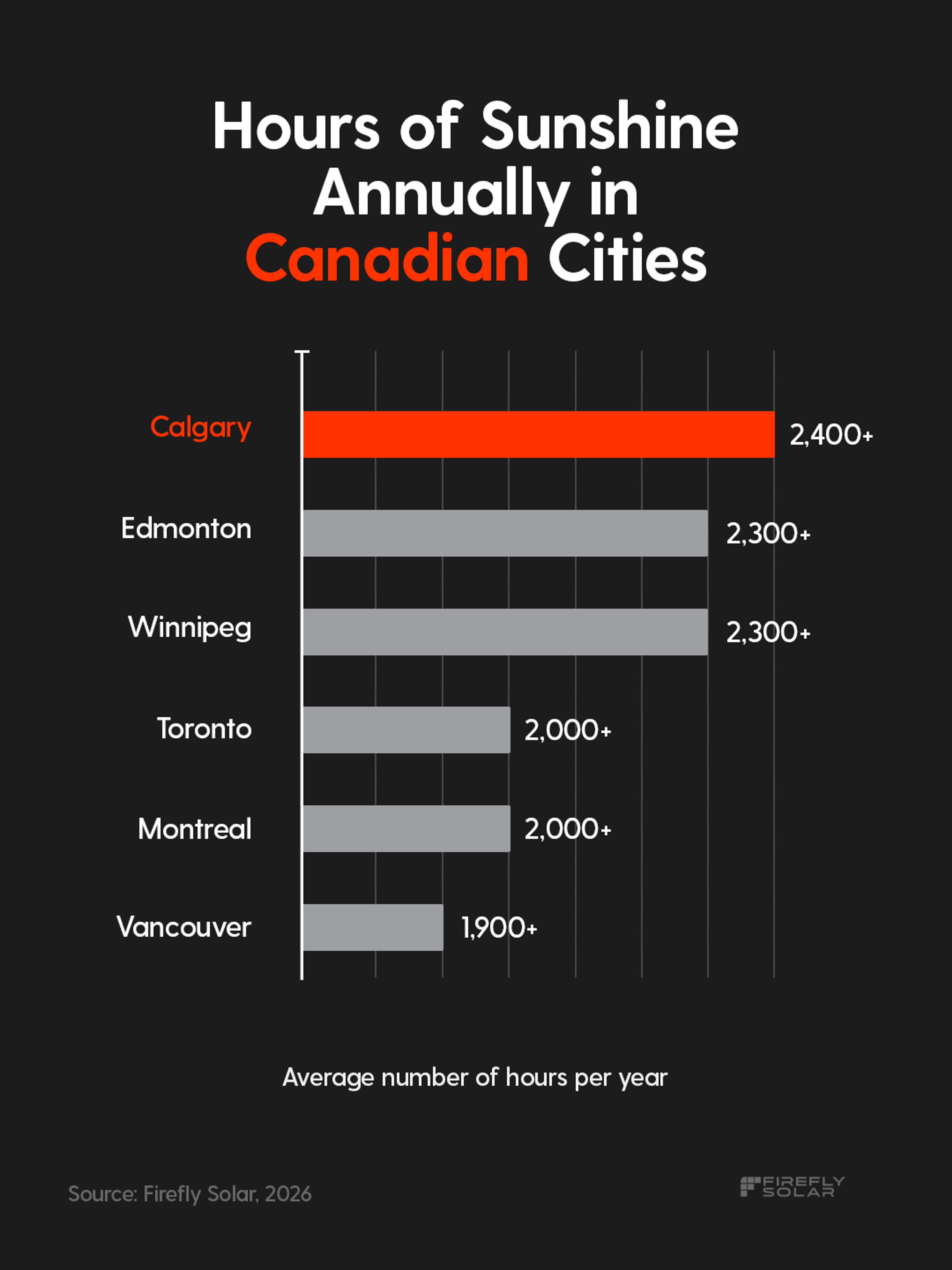
Environment and Climate Change Canada climate normals show Edmonton at 2,300+ hours of bright sunshine annually. That's higher than Toronto (2,000), Montreal (2,000), and Vancouver (1,900), and within range of Calgary (2,400+).
Long summer daylight
Edmonton's northern latitude means up to 17 hours of daylight in late June. The extended daylight window drives a heavy summer skew in production. A typical Edmonton system generates 35 to 40 percent of its annual output during May, June, and July alone.
Cold-climate efficiency boost
Solar panels are semiconductors that perform better in cold temperatures. Edmonton winter mornings at minus 10°C or lower can deliver close to or above a panel's rated wattage, while hot summer afternoons elsewhere pull panels several percent below rated output. Combined with high winter sunshine, Edmonton's cold climate is a structural advantage.
For the full mechanics, see our Canadian winters guide.
Rising electricity costs
Alberta's deregulated retail electricity market means Edmonton homeowners can choose their retailer. EPCOR Energy is the local default, but homeowners can switch to other retailers for different rate structures. Over the past five years, Alberta retail rates have trended upward.
Solar protects you on every kWh you self-consume. As rates rise, the value of every kWh your panels produce rises with them.
How much does solar cost in Edmonton?
Most residential installations range from about $15,000 to $50,000 or more, depending on system size and number of panels, available roof space, your location in Alberta, ease of installation, and additional considerations. We provide an exact quote after assessing your property.
A typical home requires an 7 to 12 kW system. Firefly Solar provides detailed, transparent quotes with a full cost breakdown and no hidden fees.
Typical Edmonton residential system size
System sizing depends on annual electricity consumption:
- Smaller homes (under 1,800 sq ft, gas heat): typically 5 to 7 kW
- Standard suburban homes (gas heat, average consumption): typically 8 to 10 kW
- Larger or all-electric homes (electric heat, EV, hot tub): typically 10 to 15 kW
- Acreages (Sherwood Park, St. Albert outskirts, rural): typically 12 to 20 kW
What's the payback period for solar in Edmonton?
Most Edmonton homeowners pay back their solar investment in 6 to 10 years. The slightly slower payback compared to Calgary reflects EPCOR's relatively lower energy charges and the absence of a city-specific solar rebate.
What moves the number
- Annual consumption. Higher-consumption homes pay back faster.
- Retailer choice. EPCOR Energy is the default, but switching retailers can change net metering credit value and overall payback.
- System sizing. Right-sized to annual consumption is the optimum.
- Self-consumption ratio. Homes with daytime electricity use (EV charging, work-from-home, heat pump) self-consume more solar at full retail value.
What incentives are available for Edmonton homeowners?
Change Homes for Climate (multi-unit only, IMPORTANT CAVEAT)
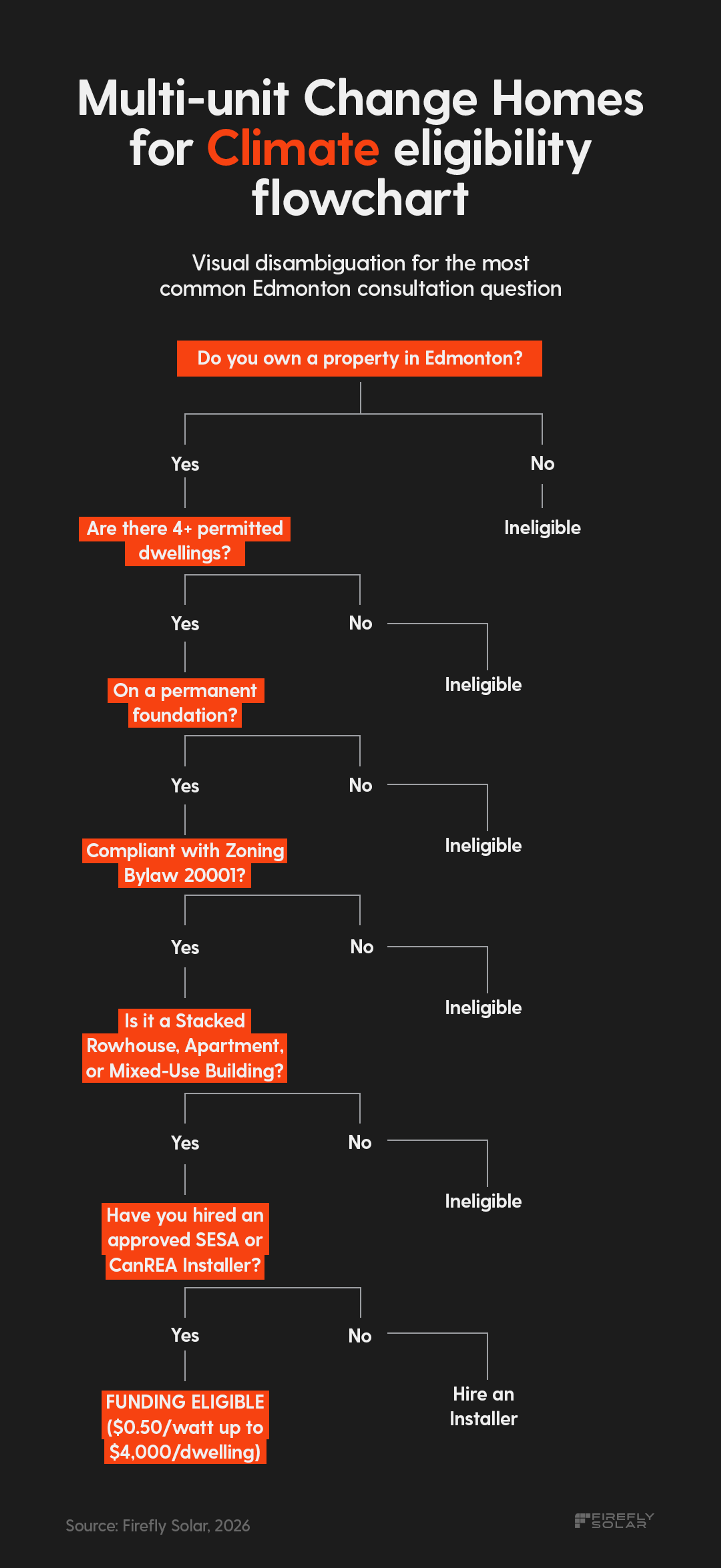
The City of Edmonton's Change Homes for Climate Program offers $0.50 per watt up to $4,000 for solar installations.
Eligibility: Multi-unit residential buildings only (condos, apartments, townhouses with shared electrical). Single-family homes are NOT eligible.
This is the most common rebate eligibility confusion we see in Edmonton consultations. Single-family homeowners regularly assume they qualify and are surprised to learn they don't.
CEIP financing in Edmonton
CEIP is available to Edmonton homeowners. It provides fixed 6% post-installation financing, attached to property tax over up to 20 years, and transfers with the property if you sell. Confirm current Edmonton participation status at /resources/incentives before applying.
Full CEIP mechanics in our Alberta rebate guide.
Net metering with EPCOR (or your retailer)
Edmonton residents enrol as micro-generators through their electricity retailer. The bidirectional meter tracks consumption and export. Settlement is annual.
The credit rate depends on your retailer. Read your retailer's net metering tariff carefully. Full mechanics in our Alberta net metering guide.
Federal programs in 2026
The Canada Greener Homes Loan closed October 1, 2025. The Greener Homes Grant closed in 2024. The federal Clean Technology Investment Tax Credit applies to commercial only.
For most Edmonton homeowners in 2026, the federal landscape is effectively closed.
Does solar work in Edmonton winters?
Yes. Edmonton's winters combine cold temperatures (which improve panel efficiency), high winter sunshine on clear days, and dry air that helps snow clear quickly. Your installer's annual production estimate already accounts for typical winter losses.
Full mechanics in our Canadian winters guide.

Should I add an EV charger or heat pump?
Edmonton homeowners with EVs or heat pumps see noticeably faster solar payback. The reason: adding load you can run during peak solar hours (mid-day for EV charging, year-round for heat pump) pushes your self-consumption ratio up. More self-consumption = more of your production offsetting full retail rates instead of being exported at lower credit rates.
If you're considering a future EV or heat pump install, factor that into your system sizing now. Right-size for your projected annual consumption (not your current consumption) to avoid the annual settlement penalty on excess production.
How do I evaluate an Edmonton solar installer?
Some Edmonton-specific signals:
- APEGA-stamped engineering** on every Alberta installation (code requirement, not premium)
- Years installing in Edmonton specifically (not years incorporated)
- EPCOR net metering enrollment fluency (your installer handles the paperwork)
- In-house service team vs subcontracted electricians (year-8 service experience)
- Industry memberships (CANREA Terawatt, Solar Alberta) and certifications (Tesla Powerwall, COR safety)
For the full evaluation framework, see our installer article. For Edmonton-specific quote comparison, see best solar companies in Edmonton. For broader provincial context, see the Alberta guide or the Solar in Canada guide .
Frequently Asked Questions
Ready to find out what solar looks like for your Edmonton home?
Every Edmonton home is different. Roof orientation, shading, retailer choice, and consumption pattern all change the math. Request a free assessment and we'll walk you through the math for your Edmonton residential home, including solar panel sizing and battery storage options.