
Alberta has the most stackable residential solar incentive landscape in Canada in 2026.
There is no single province-wide solar rebate, but several Alberta municipalities run their own programs that layer on top of CEIP financing, the Micro-Generation Regulation, and the (largely closed) federal landscape. The result is the fastest residential solar payback in Canada, typically 5 to 10 years.
At Firefly Solar, we are headquartered in Calgary and have helped thousands of Alberta homeowners stack the right combination of programs for their city, their consumption pattern, and their roof. This guide walks through every active Alberta solar incentive in 2026, what each one actually pays, who qualifies, and how to combine them.
Key Takeaways
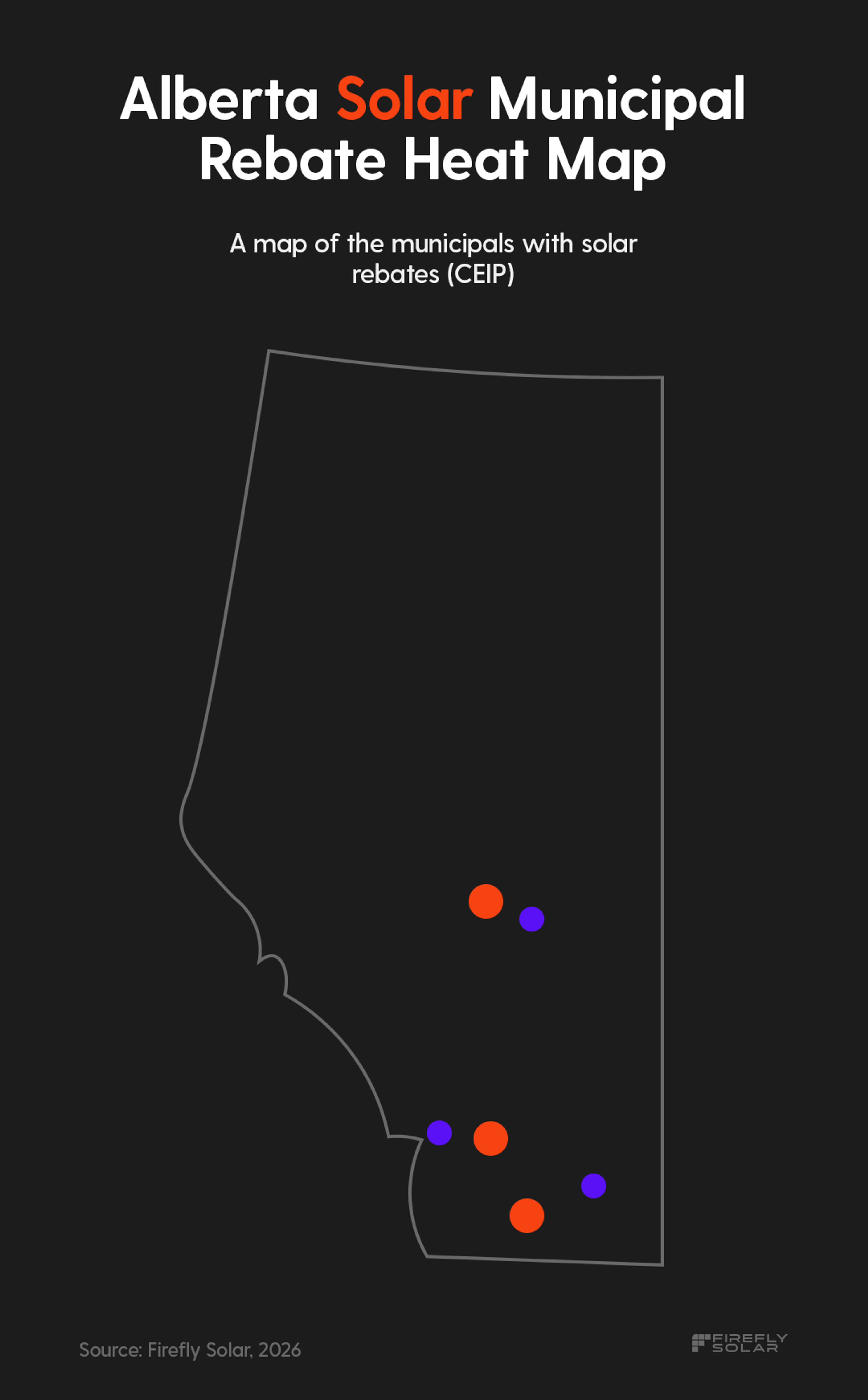
- Alberta has no province-wide solar rebate, but 5 municipalities run their own (Banff, Medicine Hat, Canmore, Wetaskiwin, Edmonton).
- The Town of Banff Solar Incentive Program is the strongest at $450 per kW residential, capped at $9,000.
- CEIP (Clean Energy Improvement Program) provides low interest post-installation financing, attached to your property tax over up to 25 years, in participating Alberta municipalities.
- The Alberta Micro-Generation Regulation enables net metering for systems up to 5 MW, with credits applied monthly and settled annually.
- Most programs stack with each other. The combined value can exceed $20,000 for a typical Banff or Canmore homeowner.
How does Alberta's solar incentive landscape work in 2026?
Alberta's solar incentive landscape has three layers: federal, municipal, and the regulatory framework that enables net metering. There is no provincial rebate.
Why Alberta has more municipal programs than any other province
Alberta's deregulated electricity market and locally-owned utilities (Medicine Hat in particular) give municipalities more flexibility to run their own energy incentive programs. The Town of Banff and the City of Medicine Hat were among the earliest Canadian municipalities to launch dedicated solar rebates. Wetaskiwin, Canmore, and Edmonton added programs later.
The result is that two homeowners in the same province can have very different rebate stacks depending on which Alberta city they live in.
How CEIP, net metering, and municipal rebates fit together
The three primary value layers for an Alberta homeowner:
- CEIP financing is not a rebate. It's a low interest loan attached to your property tax bill, available in participating municipalities. It doesn't reduce your installed cost; it changes how you pay for it.
- Municipal rebates are post-installation cash payments based on system size. They reduce your effective installed cost.
- Net metering credits under the Micro-Generation Regulation reduce your monthly electricity bill ongoing, over the life of the system.
These three layers stack. You can finance a system through CEIP, capture a municipal rebate, and earn net metering credits monthly, all on the same installation.
What municipal solar rebates exist in Alberta?
Five Alberta municipalities currently operate dedicated solar rebate programs. Each is administered locally with its own application process, eligibility criteria, and dollar amounts.
Town of Banff Solar Incentive Program
The strongest single municipal solar rebate in Alberta.
- Amount: $450 per kW installed, capped at $9,000 residential
- Type: Post-installation rebate
- Minimum system size: 2 kW
- Eligibility: Town of Banff residents; system must use approved equipment and a qualified contractor
- Application: After installation and inspection
Banff's high rebate reflects the town's aggressive municipal climate program. Combined with CEIP and net metering, Banff has the highest total incentive value of any Alberta city.
City of Medicine Hat Solar Electric Incentive
Medicine Hat is municipally-owned (the City operates its own electric utility), which is why it can offer a direct solar rebate.
- Amount: $200 per kW installed, capped at $1,000 residential
- Type: Post-installation rebate
- Eligibility: Medicine Hat utility customers; standard equipment requirements
The dollar value is lower than Banff's, but Medicine Hat's combination of high sunshine (2,500+ hours annually, the most in Alberta) and low installed costs from local labour rates means the program still drives strong adoption.
Town of Canmore residential rebate
Canmore runs a flat residential rebate for solar installations.
- Amount: Up to $1,250 flat residential rebate
- Type: Post-installation rebate
- Eligibility: Canmore residents; standard equipment requirements
Canmore homeowners typically combine this with CEIP to drive payback below the typical Alberta range.
City of Wetaskiwin Solar Grant Program
Wetaskiwin offers grants for residential and small commercial solar.
- Amount: Up to $5,000 grant
- Type: Post-installation grant
- Eligibility: Wetaskiwin residents; system size and contractor requirements apply
City of Edmonton Change Homes for Climate Program
Edmonton's program targets multi-unit residential buildings, not single-family homes.
- Amount: $0.50 per watt, capped at $4,000
- Eligibility: Multi-unit residential buildings only (condos, apartments, townhouses with shared electrical)
- Single-family homes are NOT eligible
| Municipality | Program | Headline value | Cap | Type |
|---|---|---|---|---|
| Banff | Solar Incentive Program | $450/kW | $9,000 | Post-install rebate |
| Medicine Hat | Solar Electric Incentive | $200/kW | $1,000 | Post-install rebate |
| Canmore | Residential rebate | Flat | $1,250 | Post-install rebate |
| Wetaskiwin | Solar Grant Program | Variable | $5,000 | Post-install grant |
| Edmonton | Change Homes for Climate | $0.50/W (multi-unit only) | $4,000 | Post-install rebate |
How does the Clean Energy Improvement Program (CEIP) work?
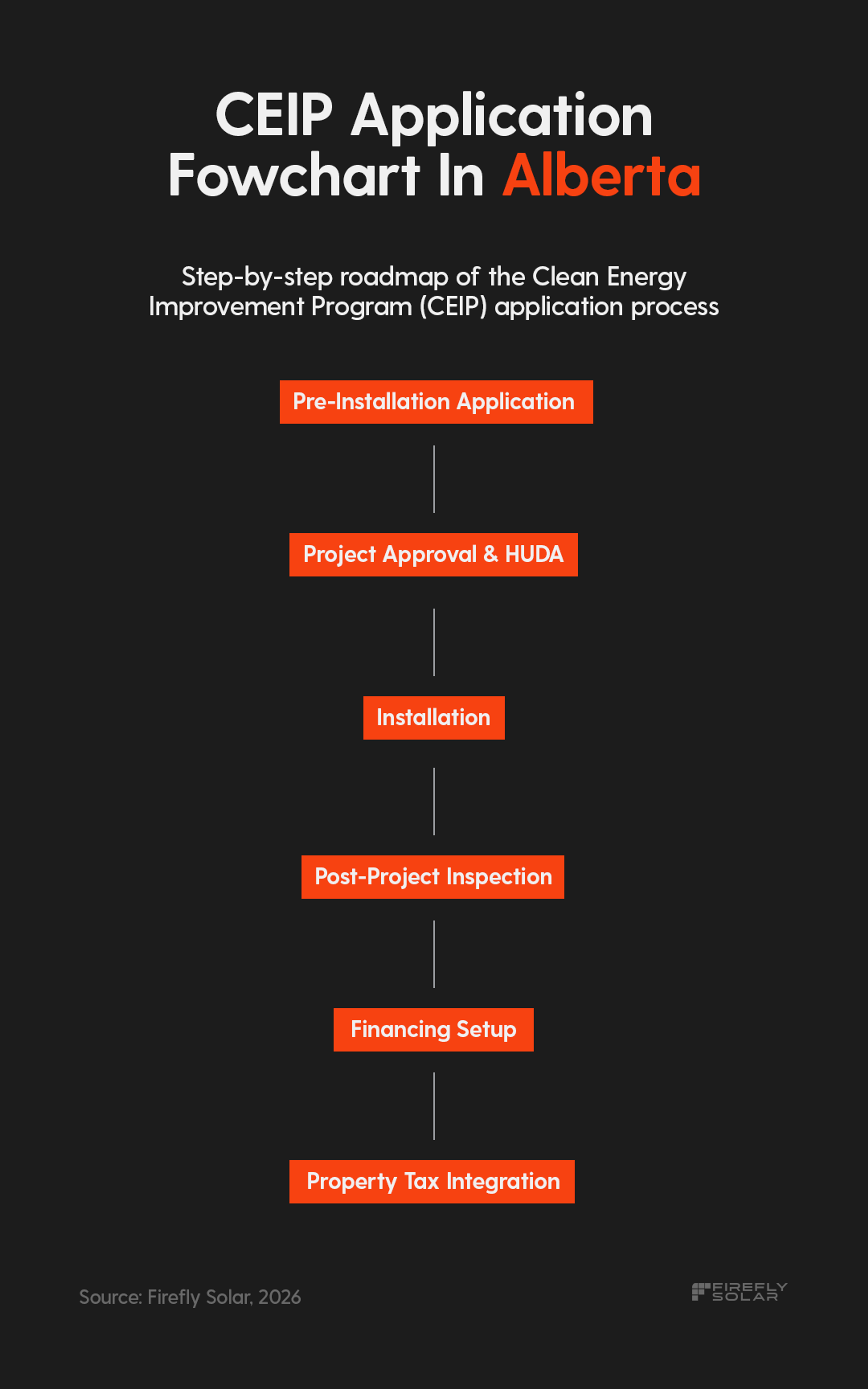
CEIP is not a rebate. It is a financing program that lets eligible Alberta homeowners pay for solar (and other clean energy upgrades) through their property tax bill, at low interest, over up to 25 years.
What CEIP is
CEIP works like a property-attached loan. After your installation is complete, the financing amount is added to your property tax assessment as a separate line item. You pay it down over the financing term as part of your regular property tax bill.
The financing transfers with the property if you sell. The new owner inherits both the system and the remaining financing balance. This is structurally different from a personal loan, which you'd have to pay off at closing.
Eligibility requirements
To qualify for CEIP:
- Your municipality must participate in CEIP (administered by Alberta Municipalities)
- You must own the property
- The installation must use approved equipment
- The contractor must be CEIP-qualified
- Your property tax account must be in good standing
Participating Alberta municipalities
CEIP availability varies by municipality. As of 2026, participating cities include Calgary, Edmonton, Banff and Canmore, Medicine Hat, Wetaskiwin, Lethbridge, Red Deer, and a growing list of smaller communities. The participating list expands regularly. Confirm at /resources/incentives before applying.
How CEIP affects payback math
CEIP doesn't reduce your installed cost. What it does:
- Removes the upfront capital barrier. You don't need to pay for the system before installation.
- Spreads payments over up to 25 years. Monthly payments are typically lower than your pre-solar electricity bill, meaning you can be cash-flow-positive from day one.
- Stays at a fixed low interest rate. Unlike a conventional loan that have high rates that can change.
- Transfers with the property. Selling within the financing term doesn't trigger a payoff.
The downside: your property tax goes up by the financing amount. This shows up on your tax statement and your mortgage lender's escrow calculations.
How does Alberta's Micro-Generation Regulation work?
The Alberta Micro-Generation Regulation is the legal framework that enables net metering for residential and small commercial solar. It has been in place since 2009 with several amendments, and is administered by the Alberta Utilities Commission.
Who qualifies as a micro-generator
To qualify under the regulation:
- System must be sized to meet your own electrical needs (not primarily for commercial export)
- Must be 5 MW or smaller (residential systems are typically 5 to 15 kW, well under the cap)
- Must use renewable or alternative energy sources (solar qualifies)
- Must be approved by your electricity retailer and your wires owner before grid connection
For typical residential homeowners, qualification is essentially automatic. Your installer handles the paperwork.
Bidirectional metering and annual settlement
Once enrolled, your existing meter is replaced (typically at no cost) with a bidirectional meter. The new meter tracks both consumption from the grid and export to the grid. Your monthly bill nets the two values.
Settlement is annual. Surplus credits accumulate over the year and are paid out by your retailer at year-end (at lower wholesale-style rates, which is why right-sizing matters).
For the full mechanics, including credit rate variation across Alberta retailers, see our Alberta net metering guide.
What federal programs apply to Alberta homeowners?
The federal residential solar landscape thinned significantly in 2024 and 2025.
Greener Homes Loan (closed)
The Canada Greener Homes Loan offered up to $40,000 interest-free, repayable over 10 years. Closed to new applications since October 1, 2025. Existing borrowers continue under their original terms.
Greener Homes Grant (closed)
The Greener Homes Grant offered $5,000 per home for energy efficiency retrofits. Closed since 2024.
Federal Clean Technology Investment Tax Credit
The CT-ITC is structured for commercial and industrial solar, not residential homeowners. It does not apply to typical Alberta residential installations.
The most useful federal program for an Alberta homeowner in 2026 is whatever installer-offered 0% financing fills the gap left by the Greener Homes Loan closure. We cover financing options on our installer pillar.
Can I combine multiple Alberta solar programs?
Yes, in most cases. Stacking is one of the structural reasons Alberta has the fastest residential solar payback in Canada.
CEIP + municipal rebate stacking
CEIP is a financing program, not a rebate, so it does not conflict with municipal rebate programs. A Banff homeowner can finance through CEIP and still receive the $450 per kW Banff municipal rebate. Same for Medicine Hat, Canmore, and Wetaskiwin.
Net metering + everything else
Net metering is a billing arrangement, not a financial program. It applies regardless of how you paid for the system or which rebates you captured.
Examples of typical stacks
| Homeowner location | CEIP available? | Municipal rebate | Combined first-year value |
|---|---|---|---|
| Calgary | Yes | None | $0 cash + 0% financing + net metering |
| Edmonton (single-family) | Yes | None | $0 cash + 0% financing + net metering |
| Edmonton (multi-unit) | Yes | $0.50/W up to $4,000 | Up to $4,000 cash + 0% financing |
| Banff | Yes | $450/kW up to $9,000 | Up to $9,000 cash + 0% financing |
| Medicine Hat | Yes | $200/kW up to $1,000 | $1,000 cash + 0% financing |
| Canmore | Yes | Up to $1,250 flat | $1,250 cash + 0% financing |
| Wetaskiwin | Yes | Up to $5,000 grant | $5,000 cash + 0% financing |
Common conflicts to avoid
- Some installer-offered promotional pricing cannot be combined with municipal rebates. Read the fine print in your quote.
- Some programs require pre-installation application; others are post-installation. Mixing the timing wrong can disqualify you.
How do I apply for Alberta solar rebates?
Application timing varies by program, but the typical sequence:
Application sequencing
- Get a quote from a qualified contractor that includes the rebate stack you intend to capture.
- Submit pre-installation applications for any programs that require them (CEIP requires pre-approval, for example).
- Install the system. Standard installation timeline is 6 to 12 weeks from contract.
- Submit post-installation rebate applications to municipalities. Most require an inspection certificate and proof of payment.
- Enrol in net metering with your retailer (your installer typically handles this).
Common documentation requirements
Across most Alberta solar rebate applications:
- Itemized invoice from your installer
- Proof of payment
- Building permit and final inspection certificate
- Equipment specifications (panel + inverter model numbers)
- Photos of the completed installation
- Property tax account number (for CEIP)
- Utility account number (for net metering and CEIP)
A good installer prepares this documentation as part of the standard installation package. If you're getting quotes, ask each installer about their rebate application support.
Frequently Asked Questions
Ready to find out what your Alberta rebate stack looks like?
Every Alberta home has a different combination of city, consumption, retailer, and roof characteristics. The only way to know exactly which programs apply to your home and how much they pay is a personalized assessment.
Request a free assessment and we'll show you the full rebate stack available at your address, the projected installed cost after rebates, and a transparent payback timeline. We serve every major Alberta market for residential installations. For the live tracker of every active Alberta program, visit /resources/incentives, or compare across the Canada-wide rebates article.