

Solar power in Alberta is the strongest residential solar opportunity in Canada.
Three things line up here that don't line up anywhere else in the country: 2,300 to 2,500 hours of sunshine annually, a deregulated electricity market with high and rising rates, and the most stackable rebate landscape in Canada. Across our work at Firefly Solar, the typical Alberta payback period sits between 5 and 10 years, faster than any other province.
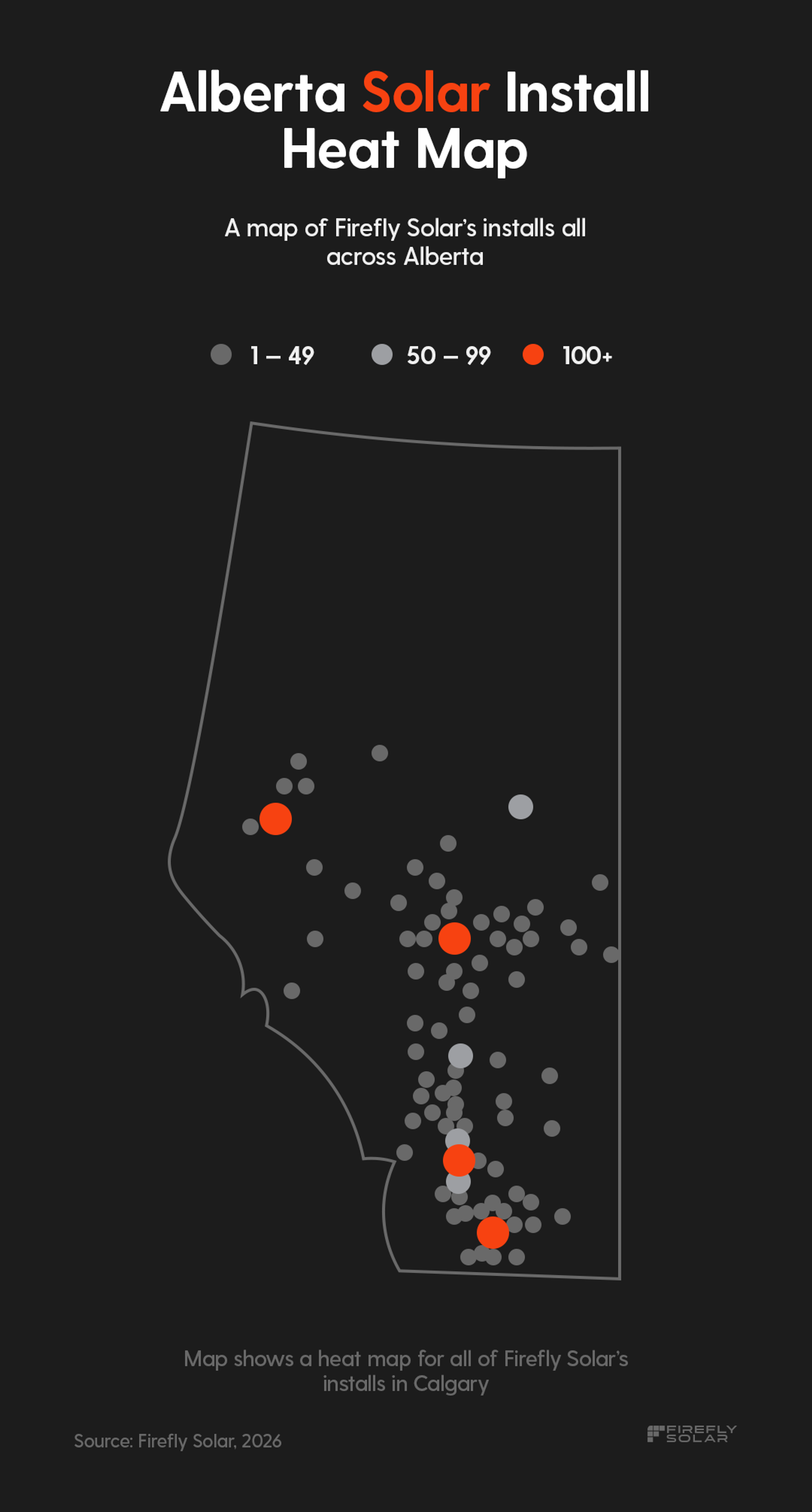
At Firefly Solar, we are headquartered in Calgary and we have been installing in Alberta for ten years initially offering solar through our sister roofing brand Kymand Roofing. We have completed more than 8,200 installations across seven provinces, with the largest concentration here at home. Our partnerships with the Calgary Flames, Cavalry FC and Home Depot, all reflect that local presence.
This guide walks you through why Alberta is the best province in Canada for solar, what installations cost in 2026, what payback looks like by city, how the Alberta Micro-Generation Regulation works for net metering, what CEIP financing actually does for your math, and what the municipal rebate landscape looks like across Banff, Medicine Hat, Canmore, Wetaskiwin, and Edmonton.
Key Takeaways
- Alberta has the fastest residential solar payback in Canada, typically 5 to 10 years.
- The Alberta Micro-Generation Regulation makes net metering available across the province for systems up to 5 MW.
- The Clean Energy Improvement Program (CEIP) provides fixed low post-installation financing in participating municipalities, attached to your property tax.
- Five Alberta municipalities run their own solar rebate programs on top of CEIP. Banff has the strongest at $450 per kW.
- The deregulated electricity market means rate volatility. Solar protects every kWh you self-consume from that volatility.
Why is Alberta the best province for solar in Canada?
Alberta combines the highest sunshine totals in Canada, a cold climate that boosts panel efficiency, and an electricity market structure that turns volatile rates into a tailwind for solar economics. No other Canadian province has all three.
Sunshine: Alberta vs the rest of Canada
Calgary, Lethbridge, and Medicine Hat consistently rank among the sunniest cities in Canada, with annual sunshine totals between 2,400 and 2,500 hours. Edmonton sits at 2,300+ hours. Red Deer, Fort McMurray, and Grande Prairie all clear 2,200 hours. By comparison, Vancouver sits around 1,900 and Toronto around 2,000.
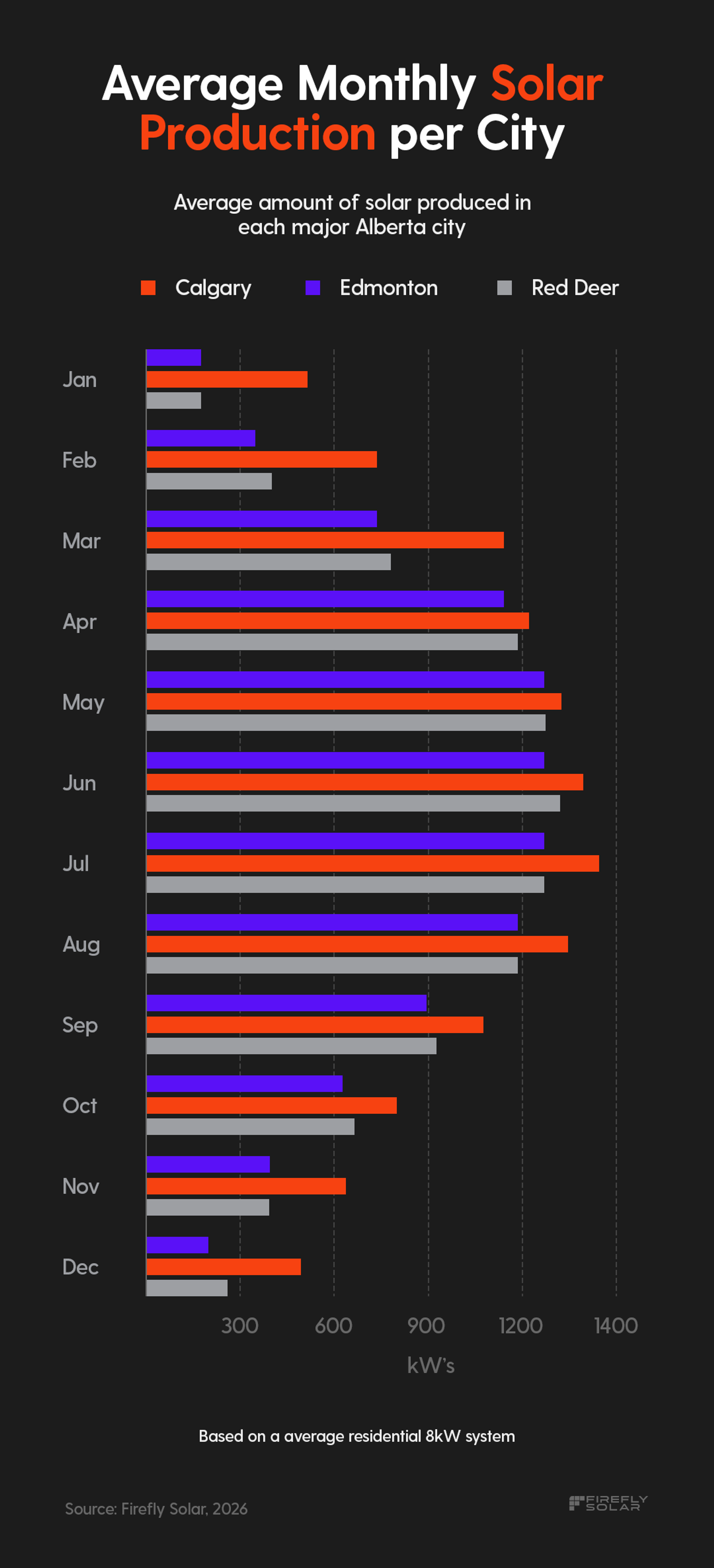
The practical implication is simple. More hours of bright sunshine means more kilowatt-hours generated per kW of installed capacity. A typical 8 kW system in Calgary produces roughly 10,000 to 11,500 kWh per year, while the same system in Vancouver produces closer to 8,000 to 9,000 kWh.
How cold-climate physics improves panel output
Solar panels perform better when cool. The temperature coefficient on a typical crystalline silicon panel sits between minus 0.30 and minus 0.40 percent per degree Celsius above 25°C. That means an Alberta winter morning at minus 5°C can deliver close to or above a panel's rated wattage, while a hot summer afternoon in Phoenix or Las Vegas pulls a panel several percent below its rated output.
Combined with our high sunshine totals, the cold-climate advantage means Alberta gets more usable production per panel per year than most homeowners assume. We cover the full mechanics in our Canadian winters guide, which explains the temperature coefficient, snow behaviour, and seasonal production curves in detail.
How Alberta's deregulated electricity market changes the math
Alberta is the only province in Canada with a fully deregulated retail electricity market. Homeowners choose their retailer, and rates can vary monthly based on wholesale market conditions. That volatility cuts both ways: it can spike your bill when wholesale prices rise, and it can drop when supply outpaces demand.
Solar protects you on every kWh you self-consume. When wholesale rates spike, you avoid the spike on the portion of your consumption your panels cover. Over a 25-year horizon, that volatility protection compounds.
For homeowners on fixed-rate plans, the immediate savings are simpler: you offset your retail rate kWh-for-kWh.
Long summer daylight hours
Alberta's northern latitude means up to 17 hours of daylight in June. That extended daylight window drives a heavy summer skew in production. A typical Alberta system generates 35 to 40 percent of its annual output during the May, June, and July window alone.
How much do solar panels cost in Alberta in 2026?
Most residential installations range from about $15,000 to $50,000 or more, depending on system size and number of panels, available roof space, your location in Alberta, ease of installation, and additional considerations. We provide an exact quote after assessing your property.
A typical home requires an 7 to 12 kW system. Firefly Solar provides detailed, transparent quotes with a full cost breakdown and no hidden fees.
Average residential system size
Across 3,500 Firefly Solar Alberta installations, the average residential system size is 7 kW.
System sizing correlates with electricity consumption. Some patterns we see across Alberta:
- Smaller homes (under 1,800 sq ft, gas heat, no EV): typically 5 to 6 kW
- Standard suburban homes (gas heat, average consumption): typically 7 to 10 kW
- Larger or all-electric homes (electric heat, hot tub, EV): typically 10 to 15 kW
- Acreages and rural homes (well pump, outbuildings): typically 12 to 20 kW
After-incentive cost
Alberta does not have a province-wide rebate that lowers your price up front. What we have is layered:
- CEIP financing can cover the full installation cost at fixed low interest rates, repayable through your property tax bill over up to 20 years. The interest rates for CEIP depend on your municipality
- Municipal rebates (Banff, Medicine Hat, Canmore, Wetaskiwin) reduce post-installation cost in those specific cities.
- Net metering credits under the Micro-Generation Regulation reduce your bill ongoing.
The full landscape lives at the Firefly Solar Incentives Tracker, which is updated monthly.
What is the payback period for solar in Alberta?
Payback period for residential solar in Alberta typically runs 5 to 10 years, the fastest in Canada. The variable that moves it most is your annual electricity consumption: a high-consumption home sees faster payback because every kWh of self-consumed solar offsets a kWh you would otherwise have purchased at retail rates.
What drives the 5 to 10 year range
Several variables move payback within that range:
- Annual consumption. A 12,000 kWh per year home pays back faster than a 6,000 kWh per year home for the same system size, because more of the production offsets retail-rate purchases.
- Retailer rate. Variable-rate plans on Alberta's deregulated market move your payback up or down month to month. Fixed-rate plans give you a predictable baseline.
- System sizing. A right-sized system (matched to annual consumption) pays back faster than an oversized system.
- Rebate stack. A Banff homeowner stacking the $450 per kW municipal rebate gets faster payback than a Calgary homeowner with no municipal program.
- Self-consumption ratio. Homes with daytime electricity use (heat pump, EV charging during the day, work-from-home) self-consume more solar and pay back faster.
Variables that move payback (consumption, roof, retailer choice)
How does Alberta's Micro-Generation Regulation work?
Alberta's Micro-Generation Regulation is the legal framework that lets homeowners generate their own electricity, connect to the grid, and receive credit for surplus exported energy. It was introduced in 2009 and has been amended several times. The Alberta Utilities Commission administers it.
Who qualifies as a micro-generator
To qualify, your system must:
- Be sized to meet your own electrical needs (the system cannot be primarily for commercial export).
- Be 5 MW or smaller (residential systems are nowhere near this cap).
- Use renewable or alternative energy sources (solar qualifies).
- Be approved by your retailer and your wires owner before energizing.
Bidirectional metering and billing
Once enrolled, your existing electricity meter is replaced (typically at no cost) with a bidirectional meter that tracks both consumption from the grid and export to the grid. Your monthly bill shows both figures, and the difference determines what you owe or what credit accumulates.
The credit rate basis varies by retailer. Most Alberta retailers credit at the energy charge portion of your retail rate, not the full retail rate (you still pay distribution and transmission charges on imports). We explain the math in detail in our net metering guide.
Annual settlement
Net metering in Alberta is settled annually. Surplus credits accumulate over the course of the year, and any unused credits at year-end are paid out by your retailer (rules vary slightly across retailers).
The practical implication: you should not oversize your system beyond your annual consumption, because excess production beyond your annual usage gets paid out at lower wholesale-style rates rather than offsetting retail-rate purchases.
What incentives and rebates are available in Alberta?
Alberta has the most stackable solar incentive landscape in Canada, but no single province-wide rebate. The value comes from layering:
- CEIP (Clean Energy Improvement Program) financing
- Municipal rebates (where your city participates)
- Net metering credits under the Micro-Generation Regulation
- Federal financing programs (limited as of 2026)
CEIP (Clean Energy Improvement Program) financing
CEIP provides fixed low interest post-installation financing for solar and other clean energy upgrades, attached to your property tax bill. Repayment runs up to 25 years (or the life of the equipment, whichever is shorter), and the financing transfers with the property if you sell.
Eligibility:
- Your municipality must participate in CEIP.
- You must own the property.
- The installation must use approved equipment and a qualified contractor.
Participating Alberta municipalities (verify current list at /resources/incentives): Calgary, Edmonton, Banff, Canmore, Medicine Hat, Wetaskiwin, and a growing list of smaller centres.
Municipal rebates by city
Five Alberta municipalities run their own solar rebate programs on top of CEIP:
- Town of Banff Solar Incentive Program: $450 per kW residential, capped at $15,000. Strongest single municipal rebate in Alberta. Minimum 2 kW system.
- City of Medicine Hat Solar Electric Incentive: $200 per kW, capped at $1,000 residential. Medicine Hat is municipally owned, which is why this program exists.
- Town of Canmore residential rebate: Up to $1,250 flat residential rebate.
- City of Wetaskiwin Solar Grant Program: $5,000 grants for residential solar.
- City of Edmonton Change Homes for Climate: $0.50 per watt up to $4,000. Multi-unit only, not single-family.
We break down each program in detail in our Alberta rebate guide.
Federal programs (current state in 2026)
The Canada Greener Homes Loan closed to new applications on October 1, 2025. Existing borrowers continue under their original 0% interest, up-to-$40,000 terms.
The earlier Greener Homes Grant ($5,000) wound down in 2024.
The federal Clean Technology Investment Tax Credit is structured for commercial and industrial solar, not residential.
The most useful federal program for an Alberta homeowner in 2026 is whatever installer-offered 0% financing fills the gap left by the federal loan.
Does solar work in Alberta winters?
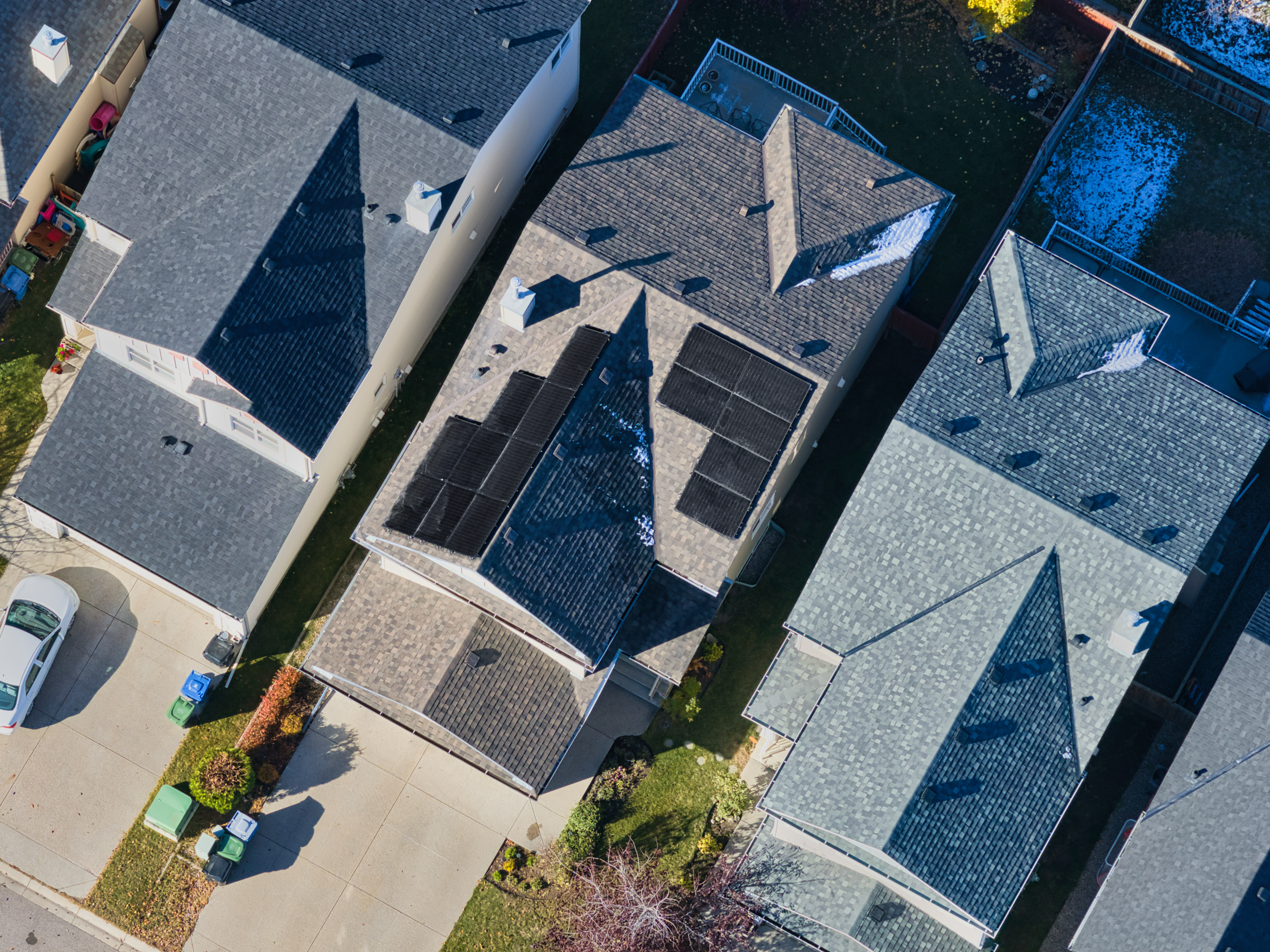
Yes. Alberta's combination of cold temperatures, dry climate, and high winter sunshine makes our winters one of the best solar environments in the country. Cold improves panel efficiency, panel angles clear most snow within a day, and your installer's annual production estimate already includes typical winter losses.
The full mechanics are in our Canadian winters guide: temperature coefficient, snow behaviour, when to clear snow yourself (mostly: don't), and what to expect from your system month-by-month.
Where in Alberta is solar best?
Solar works well across Alberta. Some cities have stronger municipal rebates, some have better sunshine totals, and Calgary and Edmonton have the deepest installer markets. Below is a quick orientation to each major Alberta city we serve.
Calgary
Calgary is Firefly's headquarters and our deepest market. 2,400+ sunshine hours, fast 5 to 7 year payback typical, CEIP available, no city-specific solar rebate. Read more in our Calgary solar guide.
Edmonton
Edmonton has 2,300+ sunshine hours and a slightly slower 6 to 10 year typical payback than Calgary, mostly due to lower retail rates with EPCOR compared to deregulated retailers. CEIP available. Change Homes for Climate is multi-unit-only. Read more in our Edmonton solar guide.
Lethbridge
Lethbridge has 2,500+ sunshine hours, the most in Alberta. 5 to 7 year typical payback. Wind-load engineering matters more here than anywhere else in Alberta, which is why every Lethbridge install we complete has APEGA-stamped engineering for the racking and structural review. Read more in our Lethbridge solar guide.
Medicine Hat
Medicine Hat ties Lethbridge for sunniest in Alberta and runs its own $200 per kW Solar Electric Incentive (up to $1,000) thanks to being a municipally-owned utility. 5 to 7 year typical payback. Read more in our Medicine Hat solar guide.
Banff and Canmore
Banff has the strongest single municipal rebate in Alberta at $450 per kW (up to $9,000 residential). Canmore runs a separate $1,250 residential rebate. Mountain installations require additional snow-load and wildlife-corridor permitting considerations. Read more in our Banff and Canmore solar guide.
Red Deer
Red Deer sits in central Alberta with 2,300+ sunshine hours and 6 to 9 year typical payback. No city-specific rebate program. CEIP is currently unavailable. Read more in our Red Deer solar guide.
Smaller communities
We also serve Wetaskiwin (which runs a $5,000 grant program), Fort McMurray, Grande Prairie, and many smaller Alberta centres. Sunshine and payback profiles are similar to the closest larger city. CEIP availability varies by municipality.
How do I choose a solar installer in Alberta?
The single biggest factor in whether your solar investment pays off over 25 years is whether the company you chose is still around to honour the workmanship warranty in year 12. The Alberta solar industry has seen a meaningful number of installer closures over the last five years, and the cheapest quote often comes from the company most likely to disappear.
Some Alberta-specific evaluation criteria:
- APEGA-stamped engineering. Every legitimate Alberta installer carries APEGA-stamped designs for structural review and electrical engineering. Anything less is a red flag.
- Years installing in Alberta. Not years incorporated. Years installing locally. Five years and several hundred local installs is the floor for a company taking 25-year warranty risk.
- Industry memberships. CANREA Terawatt members and Solar Alberta members participate in industry oversight. Firefly Solar holds both.
- Permitting fluency. The Alberta micro-generator approval process moves through your retailer, the Alberta Utilities Commission, and your wires owner. Installers without this fluency add weeks to your timeline.
We cover the full evaluation framework in our installer pillar.
Frequently Asked Questions
Ready to find out what solar means for your Alberta home?
Every Alberta home is different. Roof orientation, shading, consumption pattern, retailer choice, municipality, and rebate eligibility all change the math. The only way to know what solar would actually do for your specific situation is a personalized assessment.
At Firefly Solar, we provide detailed, transparent proposals tailored to your home, your usage, and your goals. Calgary headquartered, ten years installing across Alberta, partner of the Calgary Flames and Cavalry FC, with thousands of local installations behind us. Request a free assessment and we'll show you exactly what to expect.