

Solar panels are photovoltaic systems that convert sunlight into electricity for your home, and they work exceptionally well across Canada.
Cold winters help panel efficiency, long summer days deliver enormous output, and most provinces have a net metering arrangement that credits your bill for surplus power exported to the grid. According to Natural Resources Canada, several Canadian regions receive more annual solar irradiance than parts of Germany, the largest residential solar market in Europe.
At Firefly Solar, we have completed more than 8,200 installations across seven provinces over the past ten years. We see the same pattern in every one of them: solar pencils out faster than most homeowners assume.
This guide walks you through what solar costs in Canada in 2026, what payback looks like in your province, which rebates and financing options are still available, how net metering works, what changes in cold and snowy climates, and how to evaluate an installer for a 25-to-30 year decision.
Key Takeaways
- Solar panels work in every Canadian province. Cold temperatures actually improve panel efficiency, and snow clears faster than most homeowners expect.
- Payback ranges from 5 to 12 years depending on province, electricity rates, and rebate stack. Alberta is the fastest in the country.
- The federal Greener Homes Loan closed to new applications on October 1, 2025. Provincial and municipal programs remain active in most regions.
- Net metering is available in every province with a major utility, although the credit rules vary significantly.
- The single biggest decision you make is the installer, not the panel brand. A 25-year warranty is only as good as the company that backs it.
What is solar power in Canada?
Solar power in Canada refers to grid-connected residential photovoltaic systems that generate electricity from rooftop or ground-mounted panels. The panels feed direct current (DC) electricity into either microinverters or a string inverter, which converts it to alternating current (AC) for your home. Surplus electricity flows back through your meter into the local distribution grid, where most provinces credit it back to you under a net metering arrangement.
Canadian residential solar adoption has accelerated steadily since 2020. The Canadian Renewable Energy Association reports continued double-digit annual growth in residential installations, driven by rising electricity costs, falling equipment prices, and increasingly sophisticated provincial regulatory frameworks.
How solar works at high latitudes
Canada sits between roughly 42° and 83° north latitude, which means lower sun angles in winter and dramatically longer daylight hours in summer. Both ends of that range matter for system design.
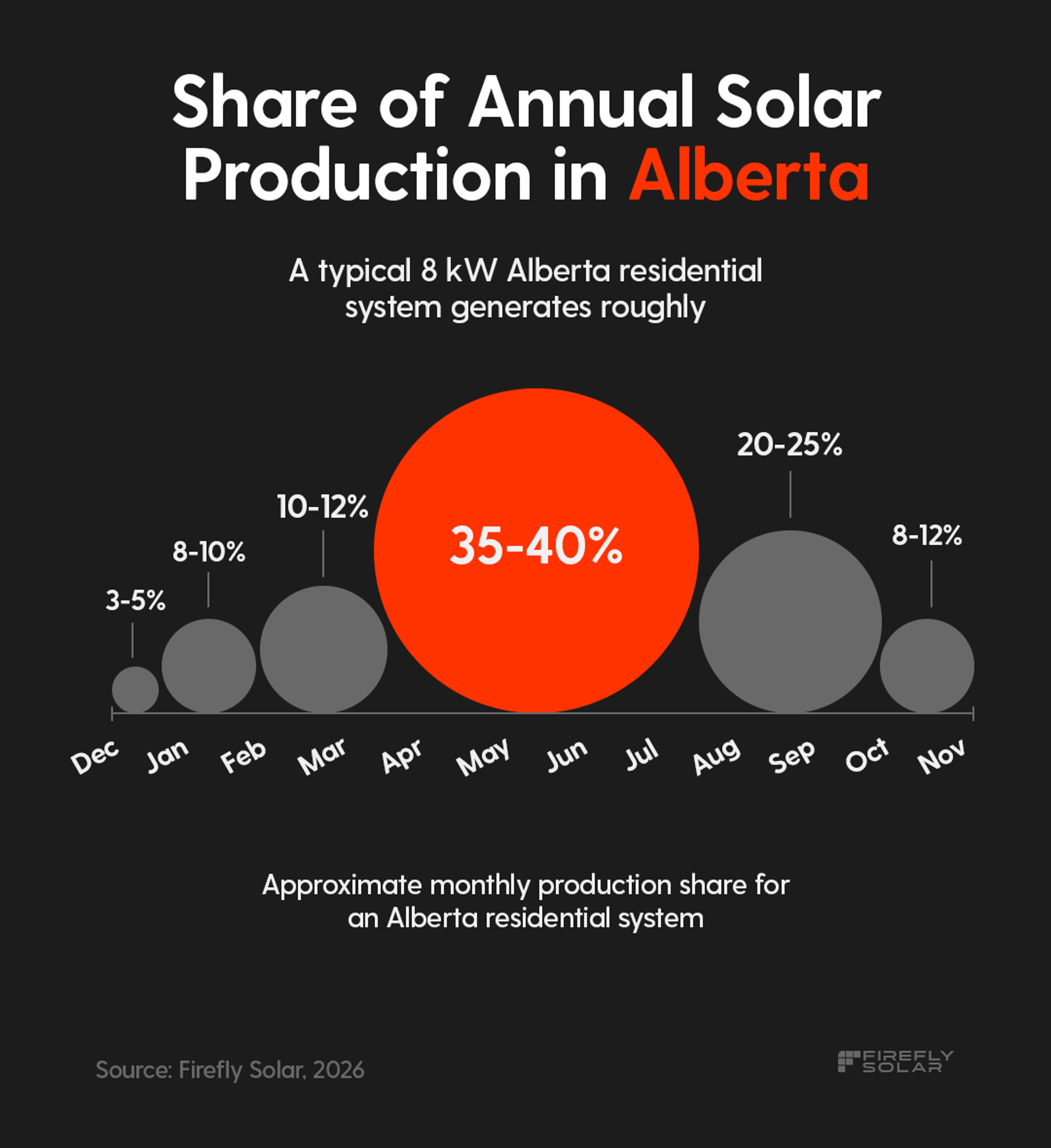
Lower winter sun angles mean each square metre of panel collects less direct irradiance per hour. Longer summer days more than compensate. A typical Alberta system produces 35 to 40 percent of its annual output during the May, June, and July window alone. Installers size your system against your annual electricity consumption, not your worst month, so the seasonal swing is built into the design from day one.
Why Canadian cold actually helps panel output
Solar panels are semiconductors. Like every electronic device in your home, they perform better when cool. The temperature coefficient on a typical crystalline silicon panel sits around minus 0.3 to minus 0.4 percent per degree Celsius above 25°C. That means a panel rated at 400 watts at 25°C delivers only about 360 to 370 watts on a 50°C summer afternoon in Arizona, but it can deliver close to or above its rated 400 watts on a clear minus 5°C Alberta morning.
A bright winter day in Calgary or Edmonton, with cold temperatures and crisp air, often produces more electricity per hour of sunlight than a hot summer day in Phoenix. We cover the full mechanics in our winter solar performance guide.
How much do solar panels cost in Canada in 2026?
The all-in cost for a residential solar installation in Canada in 2026 ranges from roughly $2.50 to $4.00 per watt installed before any incentives, with most installations landing between $20,000 and $40,000 depending on system size, roof complexity, and equipment selection. Battery storage and EV charging integration add to that base cost.
The price-per-watt has fallen by more than 60 percent over the last decade, while electricity rates in most provinces have increased meaningfully. That double tailwind is the structural reason payback periods keep shortening.
Average system size by province
Residential system sizes correlate roughly with average household electricity consumption, which varies a lot across Canada.
Smaller homes with electric heat or hot water can size up. Homes that already use natural gas for heating typically size between 6 and 9 kW. Larger acreages, agricultural buildings, and homes preparing for an EV or heat pump install commonly land between 10 and 15 kW.
Cost per watt installed
| System size | Pre-incentive cost (CAD) | After typical incentive stack (CAD) |
|---|---|---|
| 5 kW | $15,000–$20,000 | $13,000–$18,000 |
| 8 kW | $22,000–$30,000 | $18,000–$26,000 |
| 10 kW | $28,000–$38,000 | $23,000–$33,000 |
| 13 kW | $35,000–$48,000 | $29,000–$41,000 |
Costs vary by province because of labour rates, permitting requirements, snow load engineering for the Prairies, wind load engineering in southern Alberta and Atlantic Canada, and shipping for remote regions.
After-incentive cost ranges
The "after typical incentive stack" column above assumes one or more of the following applies in your region: provincial rebate, municipal rebate, federal financing program, or a manufacturer or installer promotion. The full landscape lives at the Firefly Solar Incentives Tracker, which is updated continuously.
If you want to see exactly what your installation would cost on your specific roof, with your specific utility rate, request a free assessment.
What is the payback period for solar in Canada?
Payback period in Canada ranges from 5 years in Alberta on the fastest end to 15 to 20 years in Quebec on the slowest end. The driver is the spread between your installed cost (similar across provinces), your electricity rate (highly variable), and your rebate stack.
| Province | Avg sunshine hours/yr | Typical payback (yrs) | Headline 2026 incentive |
|---|---|---|---|
| Alberta | 2,300–2,500 | 5–10 | CEIP financing + municipal rebates |
| British Columbia | 1,900–2,100 | 8–12 | BC Hydro program (verify amount) |
| Saskatchewan | 2,300–2,400 | 7–11 | SaskPower net metering |
| Manitoba | 2,300+ | 9–13 | Manitoba Hydro net metering |
| Ontario | 2,000–2,100 | 8–12 | Net metering (no major rebate) |
| Quebec | 1,900–2,000 | 12–20 | Hydro-Quebec net metering |
| New Brunswick | 1,900–2,100 | 7–11 | NB Power Total Home Energy Savings |
| Nova Scotia | 1,800–2,000 | 7–12 | SolarHomes (residential closed Apr 2025) |
| PEI | 1,800–1,900 | 8–12 | Solar Electric Rebate Program |
Why Alberta payback is fastest
Three factors line up in Alberta in a way they do not anywhere else in Canada:
- Sunshine. Alberta cities sit in the 2,300 to 2,500 annual sunshine hour range. Calgary, Lethbridge, and Medicine Hat are among the sunniest cities in the country.
- Deregulated electricity market. Albertans pay among the highest variable electricity rates in Canada, with significant volatility tied to wholesale market conditions. Solar protects you from that volatility on every kWh you self-consume.
- Stackable incentives. The Clean Energy Improvement Program (CEIP) provides post-installation property-attached financing across participating municipalities. Several Alberta cities (Banff, Medicine Hat, Canmore, Wetaskiwin) layer their own municipal rebates on top.
We cover the Alberta market in detail in our Alberta solar guide and Alberta rebate guide.
Why Quebec payback is longest
Quebec has the lowest residential electricity rates in North America, between roughly 7 and 9 cents per kWh under the Hydro-Quebec residential tariff. Solar still protects you from rate increases over a 25-year horizon, and Hydro-Quebec offers net metering, but the per-kWh value is too low to drive a fast payback. The economics improve significantly for high-consumption homes (electric heat, EVs, hot tubs, large square footage).
What incentives and rebates are available across Canada?
The Canadian solar incentive landscape has three layers: federal, provincial, and municipal. The federal layer thinned out in 2025; provincial and municipal programs still drive most of the rebate value for homeowners.
Federal programs in 2026
The Canada Greener Homes Loan closed to new applications on October 1, 2025. Existing borrowers continue under their original terms (interest-free, up to $40,000, repayable over 10 years). The earlier Greener Homes Grant ($5,000) wound down in 2024.
The federal Clean Technology Investment Tax Credit (CT-ITC) primarily supports commercial and industrial solar, not residential. It does not apply to a typical homeowner installation.
For current federal program detail, the authoritative source is the Government of Canada's energy efficiency program page.
Provincial programs by province
British Columbia. BC Hydro and Fortis offer rebates for grid-tied solar and battery storage. Verify current amounts at /resources/incentives before factoring into your payback math.
Alberta. No province-wide solar rebate, but the Clean Energy Improvement Program provides low interest post-installation financing in participating municipalities. Net metering operates under the Alberta Micro-Generation Regulation, administered by the Alberta Utilities Commission. Full detail in our Alberta net metering guide and Alberta rebate guide.
Saskatchewan. SaskPower offers net metering for systems up to 100 kW with credit at the retail rate.
Manitoba. Manitoba Hydro offers net metering for systems up to 200 kW.
Ontario. No major provincial solar rebate currently active. Net metering is available through your local distribution company.
Quebec. Hydro-Quebec operates a net metering program for systems up to 50 kW.
New Brunswick. The Total Home Energy Savings Program supports solar through NB Power. NB Power also operates a net metering program.
Nova Scotia. The SolarHomes program through Efficiency Nova Scotia previously offered $0.60 per watt up to $15,000. The residential stream closed in April 2025. The non-profit and Indigenous community streams remain active. Verify before quoting any number.
Prince Edward Island. The Solar Electric Rebate Program offers $0.50 per watt up to a $5,000 cap on residential installations.
Newfoundland and Labrador. No major residential solar program active in 2026. Net metering through Newfoundland Power.
Municipal rebates
Several Alberta municipalities run their own programs in addition to CEIP:
- Town of Banff: $450 per kW residential, up to $9,000
- City of Medicine Hat: $200 per kW, up to $1,000 residential
- Town of Canmore: up to $1,250 residential
- City of Wetaskiwin: Solar Grant Program ($5,000 residential)
- City of Edmonton: Change Homes for Climate (multi-unit only, not single-family)
Net metering eligibility by province
Net metering is the billing arrangement that credits your account for surplus electricity exported to the grid. Every Canadian province with a major regulated utility offers net metering for residential customers, but the rules vary on three axes:
| Province | System size cap | Settlement period | Credit basis |
|---|---|---|---|
| Alberta | 5 MW (micro-gen) | Annual | Retailer rate |
| British Columbia | 100 kW | Annual | Retail rate |
| Saskatchewan | 100 kW | Annual | Retail rate |
| Manitoba | 200 kW | Annual | Retail rate |
| Ontario | 500 kW | Annual | LDC rate |
| Quebec | 50 kW | Annual | Retail rate |
| New Brunswick | 100 kW | Annual | Retail rate |
| Nova Scotia | 1 MW | Annual | Retail rate |
| PEI | 100 kW | Annual | Retail rate |
The most important variable is the credit basis. Some provinces credit you at the full retail rate (you "save" the same amount you would have paid). Others credit at a lower wholesale or generation-only rate. Read your utility's net metering tariff carefully before sizing your system.
Does solar work in Canadian winters?
Yes. Solar panels work across all Canadian winters. Cold temperatures improve efficiency, snow slides off panels faster than off shingles, and your installer's annual production estimate already accounts for winter losses.
Three sentences are not enough to do justice to the question, so we wrote a dedicated guide that covers the temperature physics, snow behaviour, seasonal production curves, and what to expect month-by-month from your system. Read it here: Do solar panels work in Canadian winters?
How do I choose a solar installer in Canada?
Solar is a 25-to-30-year decision. The single biggest factor in whether your investment pays off is whether the company you chose is still around in year 12 to honour the workmanship warranty.
Company stability over sticker price
A handful of Canadian solar companies have closed in the last five years, leaving customers with manufacturer-warranty-only coverage and no in-house service team to call when something goes wrong. The cheapest quote often comes from the company most likely to disappear.
The signals that matter:
- Years operating in your specific region. Not just years incorporated. Years installing in your province or city.
- Install volume. A company that has done 5,000 installs has a more predictable failure rate than one that has done 50.
- Workmanship warranty length. Five years is the floor for serious companies. Some go longer.
- Insurance and licensing. Every legitimate installer is insured for property damage and liability. Every legitimate Alberta installer carries APEGA-stamped engineering on their designs. Every legitimate company can produce proof of either on request.
- Industry memberships. CanREA, Solar Alberta, Solar Nova Scotia, BCSEA, BBB. These are not silver bullets, but companies that participate in industry oversight are typically more accountable.
At Firefly Solar, we've been installing solar systems for 10 years initially through our sister roofing brand Kymand Roofing, completed 8,200+ installations across seven provinces, and hold 1,500+ five-star Google reviews with a 4.9 rating. We are CANREA Terawatt members, Solar Alberta members, Solar Nova Scotia members, and an Efficiency Nova Scotia member. Our designs are APEGA-stamped. We back our work with a 5-year workmanship guarantee on top of the 30-year panel and 25-year inverter manufacturer warranties.
Installation quality red and green flags
Quality differences are largely invisible from the curb until something goes wrong. Some signals you can verify before signing:
Green flags:
- The installer asks for a recent utility bill before quoting (so they can size to your actual consumption, not a generic estimate).
- The quote includes a shading analysis, not just a rooftop area calculation.
- The proposal names specific equipment models (panels, microinverters or string inverter, racking system) you can verify on the manufacturer's site.
- The installer provides photos of recent local installs.
- Production estimates are sourced from PVsyst, Aurora, or NREL's PVWatts, and the assumptions are disclosed.
- The installer carries direct manufacturer relationships (LONGi, Hoymiles, EP Cube, Tesla) rather than buying through third-party distributors.
Red flags:
- Vague warranty language ("lifetime warranty" without naming what's covered).
- Headline savings claims with no methodology behind them.
- Unwillingness to provide references or photos of recent work.
How many quotes should I get?
Two to three detailed quotes from reputable companies is enough. Five quotes creates analysis paralysis without adding meaningful information. One quote leaves you no comparison.
Our installer selection guide covers the full evaluation framework, including how to read a quote line-by-line, how to compare financing offers, and what to do if your installer goes out of business after the install.
How does solar perform in different Canadian climates?
Climate matters for two reasons: how much sunlight reaches your panels per year, and how cold or hot they get while doing it. Both numbers go into your annual production estimate.
Prairie provinces (Alberta, Saskatchewan, Manitoba)
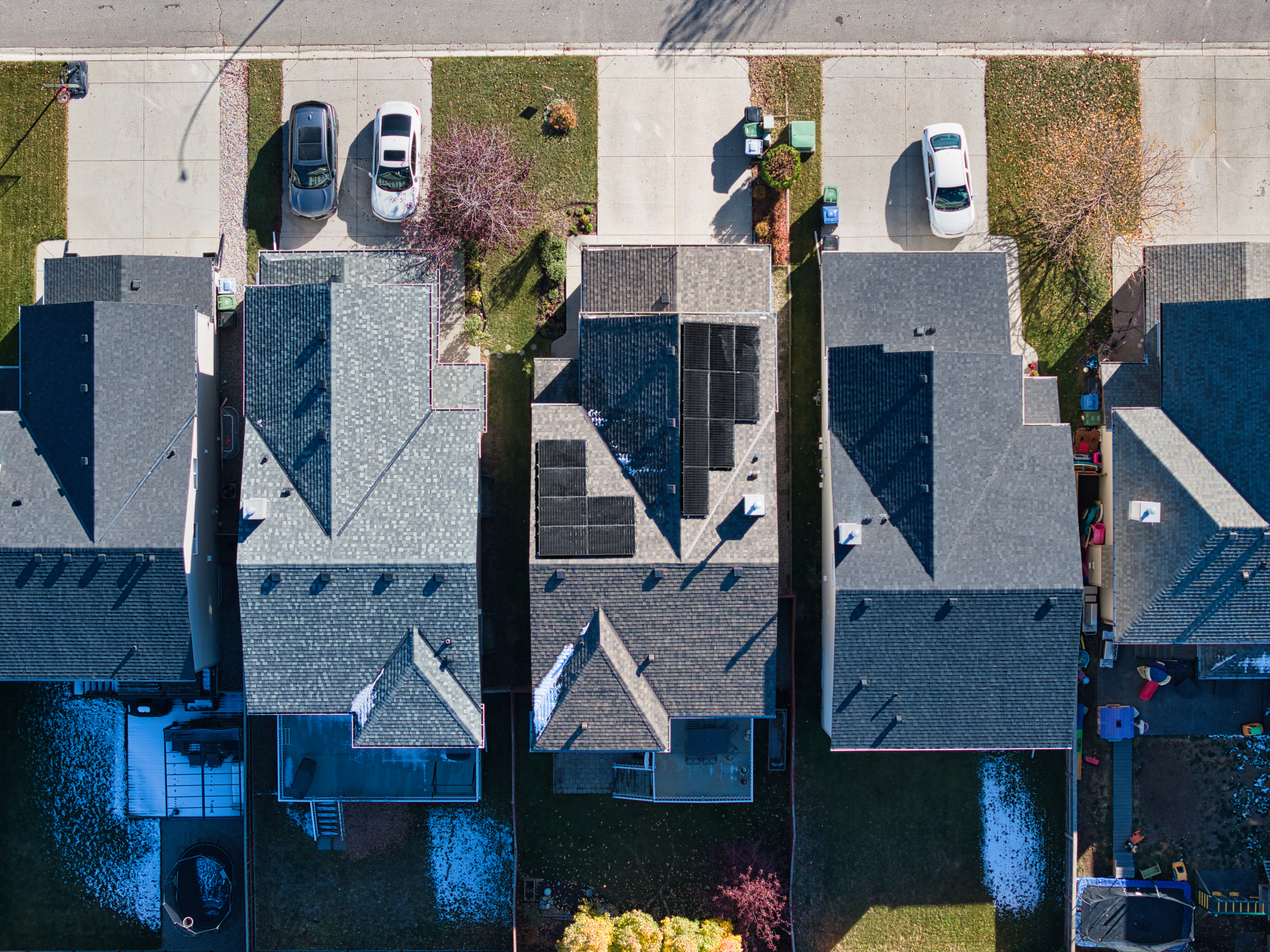
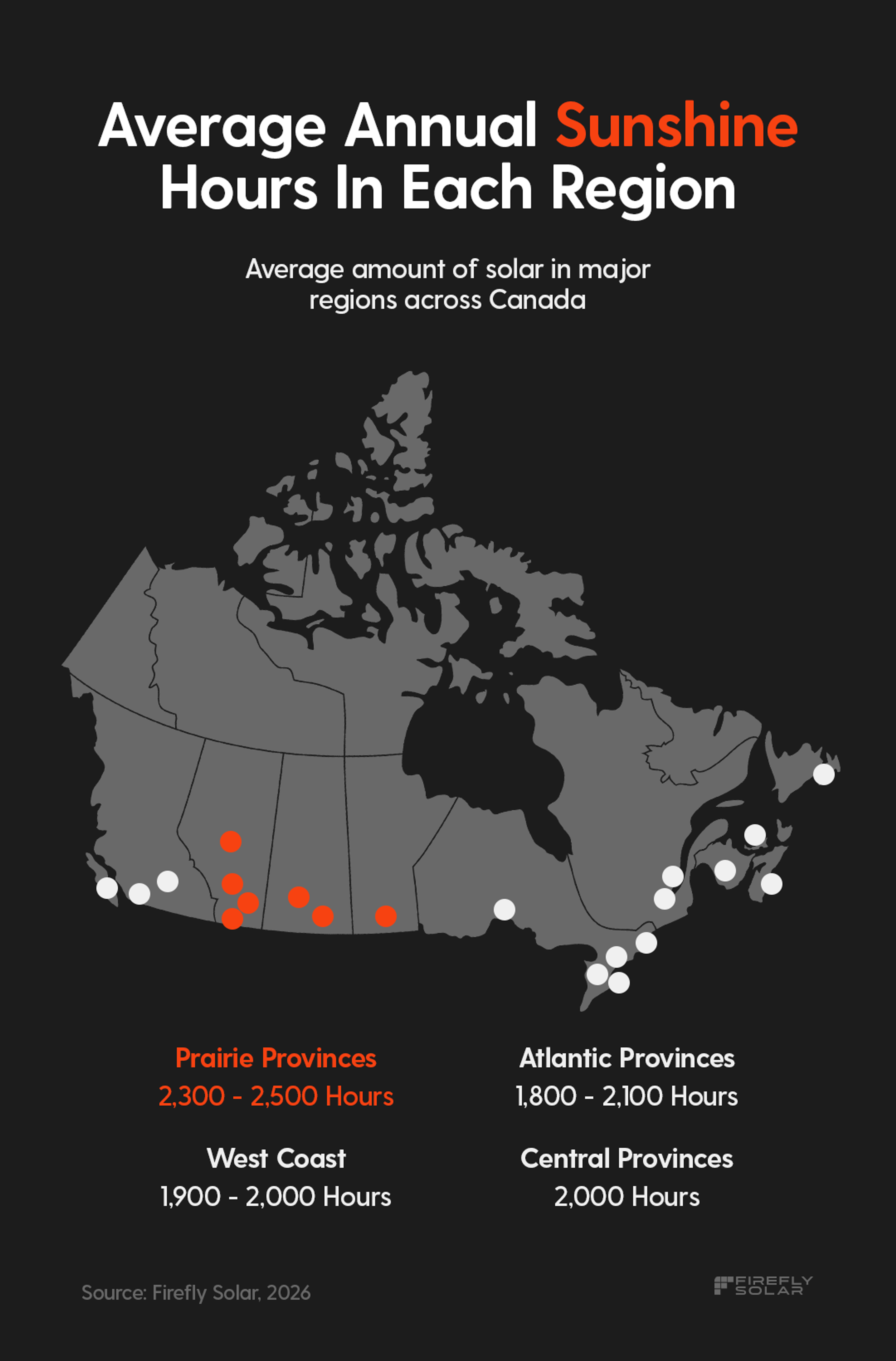
The prairies combine high sunshine hours, cold winters that improve efficiency, dry climates that reduce soiling losses, and (in Alberta) the most stackable rebate landscape in the country. Calgary, Lethbridge, Medicine Hat, Saskatoon, and Winnipeg are all in the 2,300 to 2,500 annual sunshine hour range.
Snow loads matter for racking design and structural review. Wind loads matter especially in southern Alberta. Both are handled by the engineering pass that any APEGA-stamped Alberta installer should produce as standard.
See our Alberta page, See our Saskatchewan page.
West coast (British Columbia)
The BC Lower Mainland and Vancouver Island sit in the 1,900 to 2,000 sunshine hour range, lower than the Prairies but well above Germany. The trade-off is lower irradiance against milder temperatures (less seasonal swing) and BC Hydro's relatively low electricity rates.
Coastal salt spray matters for racking corrosion resistance. Roof pitch in older BC homes can be steeper than the Alberta average, which affects installation method.
See our British Columbia page.
Central provinces (Ontario, Quebec)
Ontario sits at roughly 2,000 sunshine hours annually with electricity rates that vary widely depending on whether you're on time-of-use, tiered, or ULO. Toronto, Ottawa, London, and Windsor all support solid solar performance.
Quebec has the lowest residential electricity rates in Canada, which extends payback considerably. Solar still works as a long-term hedge against rate increases, and the climate is favourable, but the immediate economics are harder than in Alberta or BC.
Atlantic provinces (New Brunswick, Nova Scotia, PEI, Newfoundland)
Atlantic Canada has solid solar resource (1,800 to 2,100 hours) and high electricity rates, especially in Nova Scotia and PEI. The region's solar incentive landscape is more variable than Alberta's, and the Nova Scotia SolarHomes residential stream closing in April 2025 has shifted the math meaningfully.
See our New Brunswick page, see our Nova Scotia page.
Northern territories
Solar has been deployed successfully in Yukon, NWT, and Nunavut, primarily through community-scale and remote-power projects. Residential adoption is limited by the small population base and seasonal extremes, but technically the systems perform. Long summer days produce enormous daytime output. Long winter nights mean batteries or grid backup are essential rather than optional.
Frequently Asked Questions
Ready to find out what solar means for your home?
Every home is different. Roof orientation, shading, consumption pattern, electricity retailer, and rebate eligibility all change the math. The only way to know what solar would actually do for your specific situation is a personalized assessment.
At Firefly Solar, we provide detailed, transparent proposals tailored to your home, your usage, and your goals. No pressure, no obligation. Request a free assessment and we'll show you exactly what to expect.