

Solar panels work across all Canadian winters.
Cold temperatures actually improve panel efficiency, snow slides off panels faster than off shingles, and the production estimate your installer gives you already accounts for typical winter losses. Across our 8,200+ installations at Firefly Solar, the largest concentration sits in Alberta, where every system has been through multiple winters with heavy snow and temperatures well below zero. The mechanics behind why this works are well understood by physicists, manufacturers, and the Canadian Renewable Energy Association.
This guide explains the temperature physics that makes cold-weather solar more efficient than hot-weather solar, what actually happens to a snow-covered panel, why the seasonal production curve in Canada works in solar's favour, and what to expect from your system month-by-month if you live anywhere from Vancouver to Halifax.
Key Takeaways
- Solar panels are semiconductors. Like every electronic device, they perform better when cool.
- Snow on panels typically clears within a day or two without you doing anything. Panel angle and dark glass surface accelerate the process.
- Your installer's annual production estimate already accounts for winter losses. The seasonal swing is built into the system design.
- Summer production carries the year. A typical Alberta system generates 35 to 40 percent of its annual output during May, June, and July alone.
- Don't climb on a snowy roof to clear panels. The risk outweighs the production gain in almost every scenario.
How does cold weather affect solar panel output?
Cold weather improves the per-hour electrical output of solar panels. This is the opposite of what most people assume, and it's one of the structural reasons solar works so well in Canada.
The temperature coefficient explained simply
Every solar panel manufacturer publishes a "temperature coefficient" on their spec sheet. For a typical crystalline silicon panel, the coefficient sits between minus 0.30 and minus 0.40 percent per degree Celsius above 25°C.
Translated: every degree warmer than 25°C reduces the panel's output by about 0.3 to 0.4 percent. Every degree cooler than 25°C increases the panel's output by the same amount.
A 400-watt panel rated at 25°C delivers:
- About 360 to 370 watts on a 50°C summer rooftop in Phoenix
- About 400 watts on a 25°C spring day in Toronto
- About 410 to 415 watts on a clear minus 5°C winter morning in Calgary
The cold itself doesn't generate more sunlight, of course. What it does is let the panel convert each photon of incoming sunlight more efficiently into electricity.
Why Arizona panels lose efficiency in summer (and Canadian panels don't)
The conventional assumption is that more sunshine equals more electricity. That's true at the annual level (Phoenix outproduces Calgary on total kWh per panel per year), but it understates how much summer heat actually penalizes panel output.
A black-glass solar panel sitting on a hot rooftop in Phoenix can reach 60 to 70°C surface temperature on a July afternoon. At 65°C, that 400-watt panel might deliver only 340 to 350 watts. Phoenix gets the photons; the panels lose efficiency converting them.
Canadian winters reverse this. Cold ambient temperatures plus low panel surface temperatures mean every photon of sunlight gets converted at higher efficiency. We don't have as many photons in December as Phoenix has in July, but the photons we do have are converted exceptionally well.
What happens to solar panels when snow covers them?
Snow on solar panels is the most common concern Canadian homeowners raise. The reality is less dramatic than expected.
Why panel angle clears snow faster than roof shingles
Standard residential solar panels are installed at angles typically between 20 and 45 degrees, matching the pitch of your roof. The panel surface itself is smooth tempered glass, much slipperier than asphalt shingles or composite roofing.
When snow accumulates on a panel, three things start to work in your favour:
- The smooth glass has lower friction than shingles, so snow slides off easier.
- The dark glass absorbs incoming sunlight, even through a thin snow layer, and warms up.
- As the panel surface warms, the bottom layer of snow against the glass starts to melt, lubricating the slide.
For light dry snow common across the prairies, panels often clear within hours. For heavy wet snow, the process can take a day or two. Either way, you typically don't need to do anything.
How dark glass and sunlight self-clear thin snow
Even on a cloudy winter day, the dark glass of a solar panel absorbs ambient light and warms several degrees above ambient temperature. That warming is enough to melt the bottom layer of a thin snow accumulation, which then slides off as a sheet rather than melting away gradually.
This self-clearing effect is one of the reasons your installer's production estimate doesn't take a massive winter penalty: yes, you lose production during the snow event itself, but the snow doesn't sit on your panels for weeks the way it sits on your driveway.
When to clear snow yourself, and when not to
For most residential rooftop installations: don't. The risk of climbing on a snowy or icy roof to clear panels outweighs the modest production gain.
There are exceptions:
- Ground-mount systems. Easy to brush off from ground level with a soft brush.
- Low-pitch easily-accessible roofs. If you can safely reach the panels from a stable position, gentle clearing with a soft brush helps.
- Extreme snow events that won't clear naturally for an extended period. Even here, hire a professional with the right safety equipment rather than doing it yourself.
How is winter production already factored into your system design?
Every reputable solar installer sizes your system against your annual electricity consumption, using historical weather data specific to your location. Winter losses are built into that estimate from day one.
How installers use historical weather data
Production estimates for residential solar in Canada come from one of three modelling tools: PVWatts (NREL's free calculator), PVsyst (the industry standard for paid-for analysis), or Aurora (a newer tool gaining adoption). All three pull historical weather data from sources like the Canadian Weather Energy and Engineering Datasets (CWEEDS) or the National Solar Radiation Database (NSRDB).
The historical data covers 30+ years of measurements at the closest weather station to your home. It includes:
- Daily solar irradiance by month
- Cloud cover patterns by season
- Snow days per month
- Average temperatures by hour and month
When your installer runs the model, it computes expected production month-by-month, hour-by-hour, accounting for typical seasonal weather. The annual number you see in your proposal is the sum of those modelled monthly outputs.
What "annual production estimate" actually means
If your proposal shows "11,000 kWh per year," that number already includes:
- Reduced winter daylight hours
- Snow days and partial snow coverage
- Cloud cover variation across seasons
- The temperature-coefficient gain from cold months and the loss from hot months
- Soiling losses (dust, pollen, residue)
- A degradation rate (typically 0.5% per year) over the system's life
The annual number is what matters for your payback math. The month-by-month variation is a system-design output, not a deliverable to you.
How does summer production compensate for winter?
Canada's northern latitude creates dramatic seasonal variation in daylight hours and solar irradiance. The summer skew works in solar's favour.
| City | June 21 (hours) | December 21 (hours) |
|---|---|---|
| Calgary | 16.5 | 7.9 |
| Edmonton | 17.1 | 7.4 |
| Vancouver | 16.2 | 8.2 |
| Toronto | 15.4 | 8.9 |
| Montreal | 15.4 | 8.8 |
| Halifax | 15.5 | 8.9 |
That summer daylight differential is enormous. Edmonton in late June gets more than twice the daylight hours of Edmonton in late December, and the sun sits much higher in the sky, increasing irradiance per hour.
Typical monthly production share for an Alberta system
A typical 8 kW Alberta residential system generates roughly:
| Month | Share of annual production |
|---|---|
| December / January | 3 to 5% combined |
| February / March | 8 to 10% combined |
| April | 10 to 12% |
| May / June / July | 35 to 40% combined |
| August / September | 20 to 25% combined |
| October / November | 8 to 12% combined |
The takeaway: more than a third of your annual production lands in May through July. Late spring and summer carry the year. Winter contributes meaningfully but isn't where the bulk of your kWh come from.
Where in Canada does solar perform best in winter?
Different Canadian regions have different winter solar profiles, driven by sunshine totals, snow patterns, and ambient temperatures.
Prairie advantage (cold, dry, sunny)
Alberta, Saskatchewan, and Manitoba combine three favourable factors:
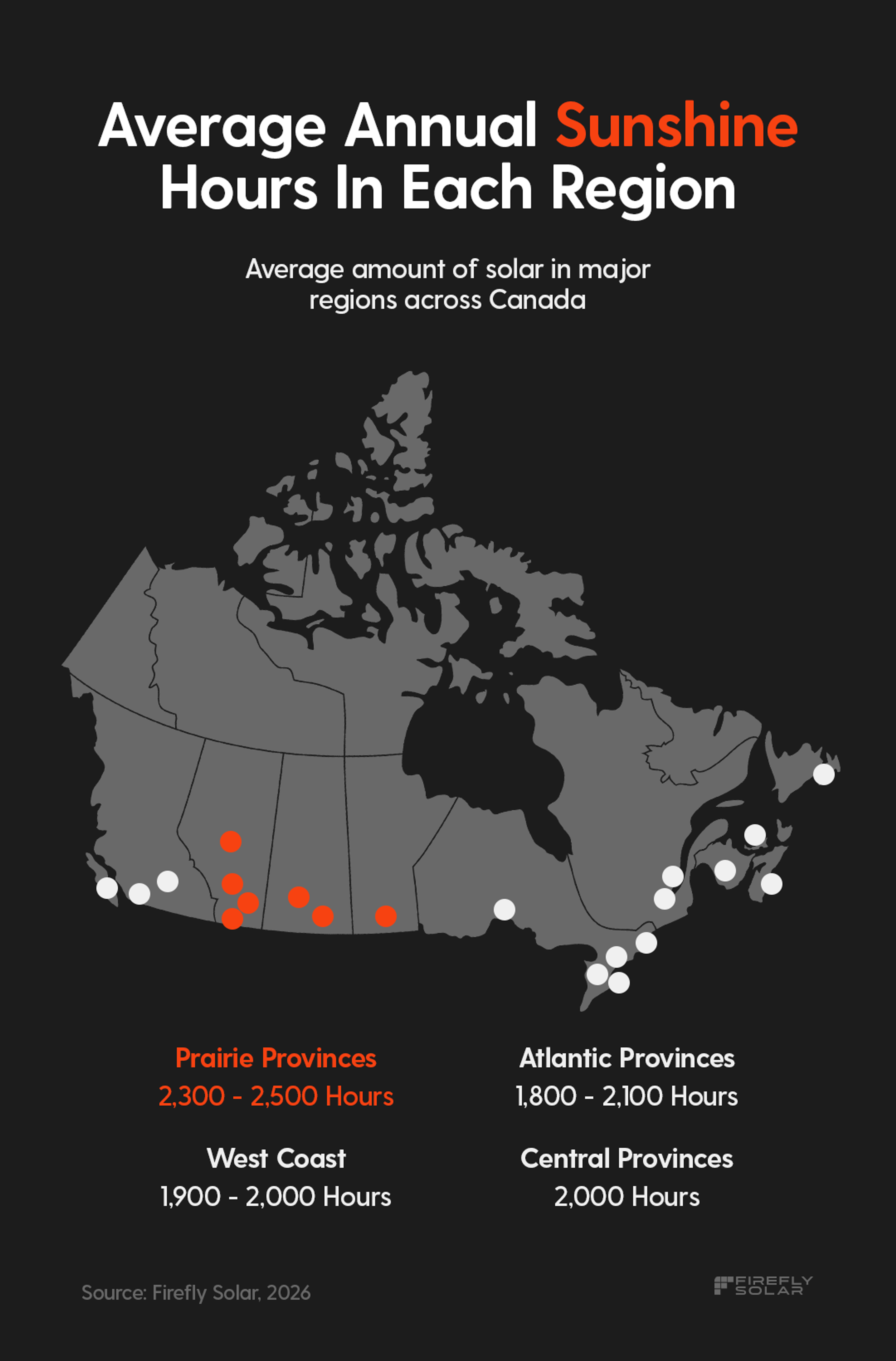
- High sunshine totals. Calgary, Lethbridge, and Medicine Hat clear 2,400 to 2,500 hours of bright sunshine annually, the highest in Canada. Edmonton, Saskatoon, and Winnipeg sit at 2,300+ hours.
- Cold-climate efficiency boost. Cold ambient temperatures mean panels operate at higher efficiency on every clear day.
- Dry climate. Less precipitation means less snow per event, and dry powder snow clears panels faster than wet coastal snow.
The combination means the prairies are the strongest winter solar environment in Canada. Read more in our Alberta solar guide, our Calgary city guide, or the broader Solar in Canada article.
Coastal trade-offs (mild, cloudy)
Coastal British Columbia (Lower Mainland, Vancouver Island, Sunshine Coast) has milder winters than the prairies, which means panels don't get as much cold-weather efficiency boost. The trade-off is less snow accumulation. Wet coastal winters mean more cloudy days and lower irradiance, but less snow-day production loss.
Atlantic Canada (Nova Scotia, New Brunswick, PEI, Newfoundland) sits between coastal BC and prairie conditions. Cold winters with moderate snow and substantial cloud cover.
Central provinces baseline
Ontario and Quebec have moderate winters by Canadian standards, with snow accumulation that varies significantly by location (Toronto vs Sudbury vs the Eastern Townships). Solar performance is solid across Ontario; Quebec's lower electricity rates affect payback math more than its winter performance affects production.
How does winter affect specific solar equipment?
A few hardware-specific notes for cold-climate operation:
Inverters and microinverters. Modern inverters and microinverters from manufacturers like Hoymiles, Enphase, and Gietron are rated for operation down to minus 40°C or lower. They are designed for Canadian conditions.
Batteries. Lithium-ion battery storage systems like the Tesla Powerwall and EP Cube include thermal management. They self-heat during cold weather to maintain optimal operating temperature. Battery efficiency drops slightly in deep cold, but the systems are designed to handle it. Read more on our battery storage page.
Racking and mounting. Alberta installations are engineered for snow loads as part of the standard APEGA-stamped design. Wind loads matter especially in southern Alberta and along Atlantic coastlines. Every reputable solar panel installer factors both into the mechanical design.
Cabling and connectors. Outdoor-rated cables and connectors are standard on solar installations. They're designed for the temperature swing between Canadian summers and winters.
Frequently Asked Questions
Ready to find out what solar would do for your home in winter and beyond?
Canadian winters are not a barrier to solar success. Thousands of residential Canadian homes generate clean electricity year-round across every province where Firefly Solar operates. If you're considering solar, a personalized assessment will show you exactly what to expect on your specific roof, your specific consumption pattern, and your specific climate.
Request a free assessment and we'll walk you through the math.